A cracked or broken sewer pipe rarely announces itself with one big failure. It leaks a little, lets in a few roots, lets out a little sewer gas, and the symptoms show up in places that do not look connected: a smell in the hall bath, a wet patch by the driveway, flies in the laundry room. This guide takes each symptom one at a time and covers what it usually means, what else can cause it, how a camera confirms it, and what to do next.
If you want the short checklist, start with 7 signs your sewer line is failing. If you are deciding whether to book an inspection, see signs you need a sewer camera inspection. This post goes deeper into what each symptom tells you about the pipe itself.
Why sewer pipes crack in older LA homes
Many houses in Burbank, Glendale, North Hollywood and the rest of the San Fernando Valley still have their original laterals. Vitrified clay comes in short sections, and its joints open as soil moves, roots push in and earthquakes shift the line. Cast iron under slabs rusts and scales from the inside until the bottom of the pipe splits. Orangeburg pipe from mid-century tracts slowly flattens. Our guide to clay, cast iron and Orangeburg pipe explains each. Once a joint opens, tree roots find it, and the crack usually grows.
Symptoms at a glance
| Symptom | What it can mean | Rule out first | What the camera looks for |
|---|---|---|---|
| Sewer smell | Gas escaping from a crack or open joint | Dry trap, loose toilet wax ring, vent problem | Cracks, separated joints, missing pipe |
| Soggy, sunken or extra-green yard strip | Wastewater leaking into the soil | Irrigation leak, water service leak | Break or open joint at the matching footage |
| Slow drains and repeat clogs | Roots, offsets or broken pipe catching waste | A single fixture clog | Root masses, offsets over 1/4 inch, debris piles |
| Rats, roaches, drain flies | Pests using a break to get in or breed | Dirty traps, gaps around doors and vents | Holes, separations, voids around the pipe |
| Damp floor, mold, new slab cracks | Leak under the house or slab | Water supply leak, shower pan leak | Cracked or split cast iron under the slab |
| Backups at the lowest drain | Main line restricted or partly collapsed | Branch line clog | Collapse, heavy roots, standing water |
1. A sewer smell that will not go away
What it means: a working drain system is sealed, with gas leaving through the roof vent. A rotten-egg smell indoors, at the cleanout or in the yard means gas is getting out somewhere else. OSHA's hydrogen sulfide page notes people can smell it at very low levels, so the nose finds a problem early.
Rule out first: pour water into rarely used drains and floor drains, check that toilets are tight to the floor, and read our sewer smell guide. If the smell comes back after that, the pipe is the suspect.
Confirm and next step: a camera looks for cracks and open joints near where you smell it. Under a slab, a smoke test can show where gas escapes. If the smell is strong inside, ventilate and call.
2. A soggy, sunken or extra-green strip of yard
What it means: a leaking lateral feeds the soil above it. Plumbing guides such as HRI Plumbing's warning-sign table describe the extra-lush stripe as sewage acting as fertilizer. Over time the leak washes soil away, and you get soft spots or small sinkholes along the path to the street.
Rule out first: sprinkler leaks and the water service line can do the same thing. Turn off irrigation for a few days and check your water meter for movement with everything off.
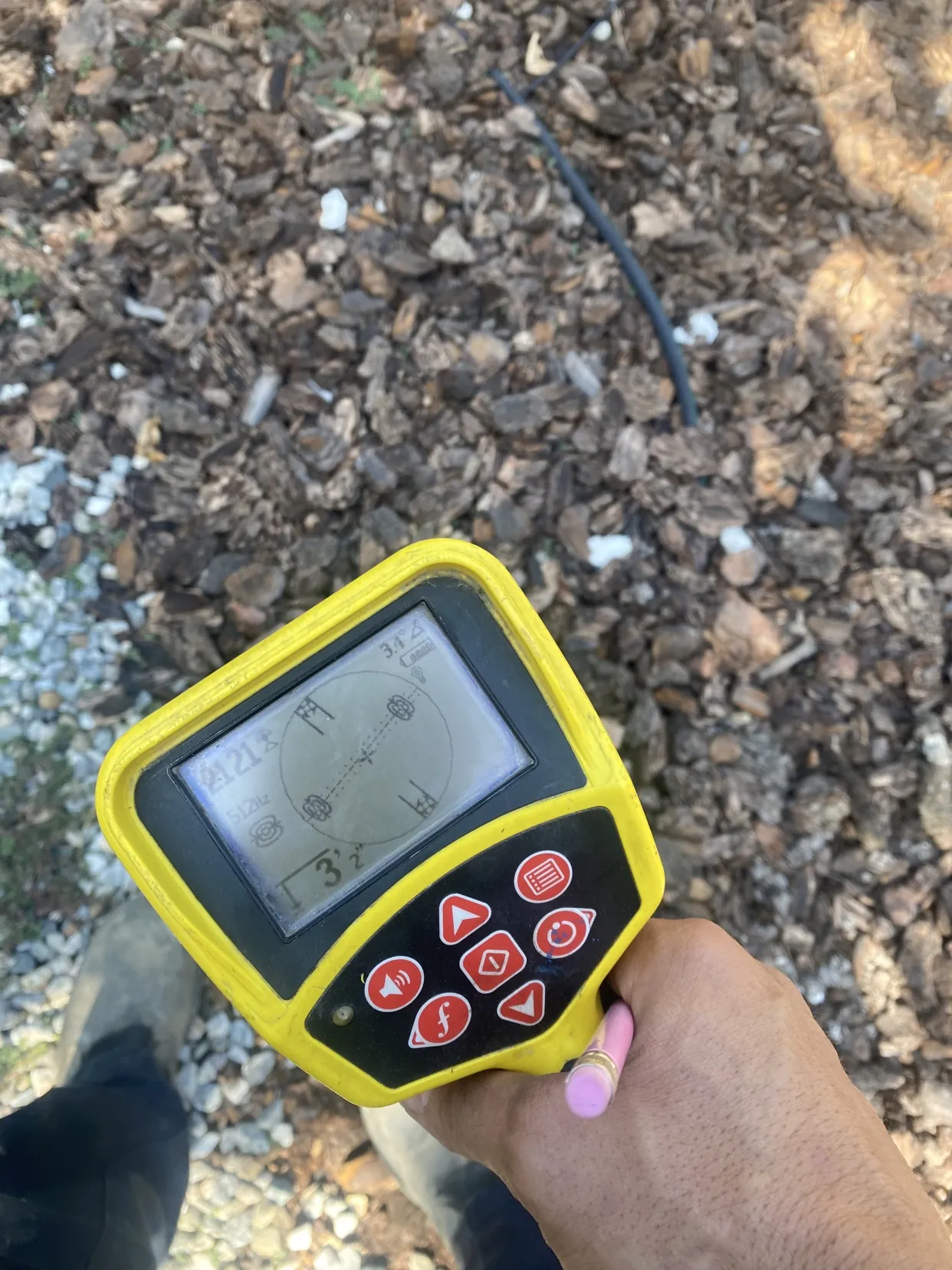
Confirm and next step: the camera's footage counter is matched to the wet spot, and a locator marks the break and its depth on the surface. Stay off sunken areas until the line is checked.
3. Slow drains and clogs that keep coming back
What it means: one slow sink is a fixture clog. Several drains slowing at once, or a main line that clogs again within weeks of clearing, points to something catching waste in the main: roots through a crack, an offset joint, or a broken section. See why a main line keeps backing up.
Confirm and next step: clear the line, then run the camera. InterNACHI's sewer scope standards tell inspectors to report visible cracks, root intrusion, offsets over 1/4 inch and more than 1 inch of standing water as needing correction. Standing water in a dip is often a sewer line belly, a different problem with a different fix.
4. Rats, roaches and drain flies
What it means: a sound sewer pipe is closed to pests. A broken one is not. The Allegheny County Health Department explains that rats find breaks and separations in old clay sewer pipe and can climb the house drain to a floor drain or toilet, and it says a plumber's sewer camera is how to check. King County Public Health also links rats in toilets to old side sewers. For flies, the Alabama Cooperative Extension System lists leaking pipes under a slab and soil soaked by a broken sewage pipe as breeding sites.
Rule out first: clean every trap and overflow. Tape over drains overnight to see which one the flies come from. If none of them does, the source may be under the floor.
Confirm and next step: camera the lateral and the lines under the house. Colonial Pest Control describes water-level tests, smoke tests and video as the ways to find a break under a slab without opening it. Fix the pipe first, then deal with the pests, or they return.
5. Damp floors, musty smells and new slab cracks
What it means: cast iron drains under a slab can split along the bottom and leak into the soil under the house. Signs include damp or stained flooring near bathrooms, a musty smell, and new cracks. The EPA's mold guide says the key to mold control is fixing the moisture source.
Rule out first: a supply-line leak can look the same. Our slab leak warning signs page covers the water-meter test that separates the two.
Confirm and next step: a camera through the cleanout or a toilet flange can show cracked or scaled cast iron. Next steps range from a spot repair to lining to rerouting.
6. Backups at the lowest drain
What it means: when the tub fills as the toilet flushes, or sewage shows at a floor drain or the cleanout, the main is badly restricted. A partly collapsed pipe or a heavy root mass are common causes. See tub and toilet backing up together.
Next step: stop using water and follow our sewer backup steps. This is the one symptom that is an emergency.
What the camera finds, and what usually comes next
| Camera finding | Usual next step |
|---|---|
| Hairline crack, pipe round, no roots | Note it, recheck on camera, or line it if it is near other defects |
| Open joint with roots, rest of pipe sound | Clear roots, then spot repair or trenchless lining |
| One broken or missing section | Spot dig and replace that section (see repair vs replacement) |
| Belly with standing water | Dig and re-lay to grade (see sewer line belly) |
| Collapse, Orangeburg, or many breaks | Full replacement, open trench or trenchless (see trenchless vs digging) |
Whatever the finding, ask for the video file, the footage counter marks and the depth. The Oro Loma Sanitary District advises homeowners to get a copy of camera results and footage and to get a second opinion. More on the inspection itself is on our sewer camera inspection page.
Published cost ranges (not Rooter Pros prices)
These are market figures published by other plumbers and cost guides, checked November 2026. Use them to sanity-check a bid, not as a quote.
| Job | Published range | Source |
|---|---|---|
| Sewer camera inspection, LA | $150–$450 | Expertise Plumbing & Rooter |
| Spot repair, one bad section | $3,000–$8,000 | A+ Electric & Plumbing; Alpha-Beta Plumbing |
| Spot repair (Burbank cost guide) | $1,000–$3,000 | PRO Plumbers of Burbank |
| Lining or trenchless replacement | $6,000–$15,000 (A+); $8,000–$18,000 (Alpha-Beta) | A+; Alpha-Beta |
| Full open-trench replacement | $10,000–$25,000+ | A+; Alpha-Beta |
Length, depth and what sits on top of the pipe move you inside those ranges. Full totals are in our sewer line replacement cost guide.
Who owns the pipe
In the City of Los Angeles, LA Sanitation says property owners are responsible for the entire private lateral, from the building to the street connection, including the part under the street. Burbank also puts the lateral on the owner, and its SLURP program offers credits for lateral cleaning, video and replacement. Check current rules before work under a sidewalk or street.
Getting it checked in Burbank, Glendale and the Valley
Rooter Pros runs the camera, shows you the footage on site, marks the problem on the surface, and gives free estimates with flat-rate pricing for the options that match the video. Licensed & bonded (CSLB #917630), open 24/7, no overtime charges. Seniors, active military and veterans get 10% off; mention it when you call (818) 669-9019.
Smell, wet yard, flies or repeat clogs? Let us put a camera in the line and show you what is going on. Rooter Pros is licensed & bonded (CSLB #917630), with free estimates, flat-rate pricing and no overtime charges.
Call (818) 669-9019Symptom and inspection guidance draws on the public health, extension, industry and contractor sources linked above (including InterNACHI sewer-scope standards, OSHA, EPA, King County and Allegheny County health departments, and LA Sanitation). Prices in the table are typical published ranges from other plumbers and cost guides as of November 2026; they are not Rooter Pros quotes and change over time.