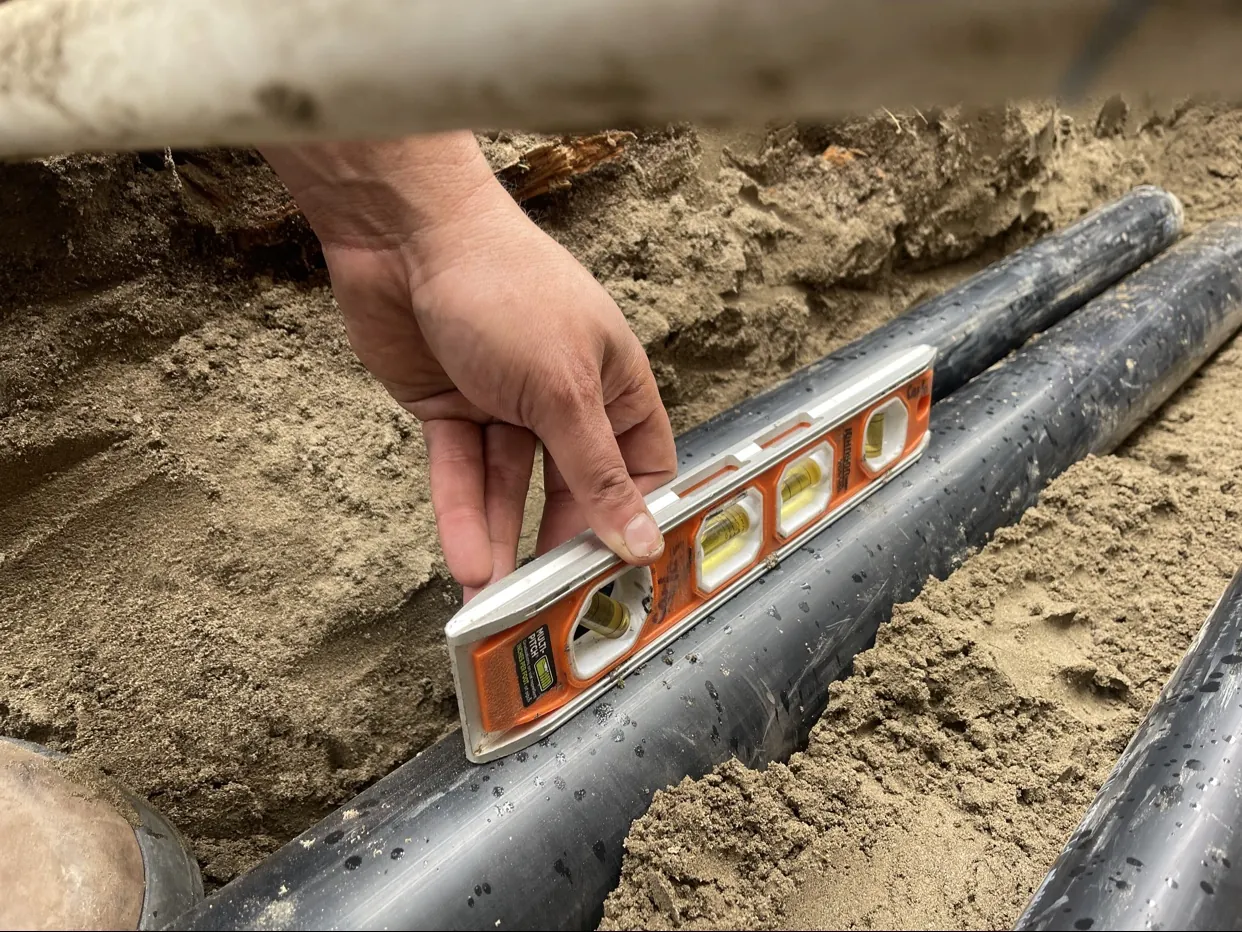
When the same toilet or tub backs up again weeks after it was cleared, the clog is often a symptom. In older Burbank, Glendale and San Fernando Valley laterals, one of the structural causes is a belly: a low spot in the pipe that holds water and solids so the line clogs in the same place. A cable can punch through that pool, but it does not remove the dip.
This post is the belly deep-dive. For the broader backup causes, see why a main line keeps backing up. For how to read the rest of a scope, see what a sewer camera shows. For spot dig vs whole-line decisions, see sewer line repair vs replacement.
What a sewer line belly is
Sewer laterals run on gravity. Plumbing codes want horizontal drainage laid at a steady fall—commonly at least 1/8 inch per foot on typical 3- to 6-inch building sewers under the International Plumbing Code, as summarized in field guides such as Georgia Sewer's sewer-line belly guide. A belly interrupts that fall: the pipe drops into a low point and then rises out of it. Water fills the dip up to the downstream lip and sits there after the house stops draining. Solids settle where the flow slows, so the low spot becomes the place where paper, grease and wipes keep collecting.
Bellies form when the ground under the pipe moves or was never prepared well—soft trench bottom, loose backfill, washout from a leak, nearby digging, or soils that settle over decades. Older clay and cast-iron Valley laterals are especially prone once joints open; see clay, cast iron and Orangeburg sewer pipes.
What a belly looks like on camera
On a good video, a true belly usually looks like this: the water gets deeper as the camera moves forward, sometimes until the lens goes under, then falls back to a normal level farther down the line. Industry training (NASSCO's guidance on water-level sags, as cited by Georgia Sewer) teaches operators to record where the sag begins, how deep the water gets at its lowest point, and where it ends. InterNACHI's sewer scope standards tell inspectors to report more than 1 inch of standing water as a condition needing correction.
Not every puddle on the screen is a belly. Debris under the water, leftover flow, or a tilted camera head can fake a sag. TSR Trenchless and Shelton Plumbing both stress useful footage notes length and depth—not just "some water in the line"—and that nobody should run water while the camera records a quiet baseline. Ask for the recording, counter marks, and a surface locate of the low spot before you price a dig. See our sewer camera inspection page and camera cost guide.
Symptoms that point to a sag
- The same backup keeps returning after snaking or cleaning, often at the same fixture pattern.
- Slow drains that clear, then return — the pool drains slowly once flow stops, then loads up again.
- Gurgling or sewer smell when other fixtures run, especially if a cleanout shows standing sewage (sewer smell, gurgling drains).
- Camera standing water that lines up with your clog history, often with solids sitting in the pool.
Those signs overlap with roots, offsets and breaks. The camera separates a belly from the rest—see signs your sewer line is failing.
Why trenchless lining usually fails on a belly
HAUSE's trenchless-and-belly guide puts it plainly: lining and pipe bursting take their shape from the old pipe. A CIPP liner cures against the host wall and copies the dip millimetre for millimetre. A bursting head follows the old channel, sag included. You can end up with a smooth new pipe that still holds water.
That does not make trenchless useless. Cracks, leaking joints and root entry in pipe that still holds its shape are lining candidates—see trenchless sewer lining and trenchless vs digging. A common honest plan is to dig and re-lay only the bellied section, then line the remaining sound run. Anyone who says lining alone "fixes" a meaningful sag is selling grade you will not get.
Fixes that actually change grade
| Situation | Usual approach | Notes |
|---|---|---|
| Shallow sag, sound pipe, little or no backup history | Monitor + scheduled cleaning | Cleaning clears solids but leaves the dip; recheck on camera if symptoms appear |
| One measurable belly, rest of line sound | Spot dig, re-bed, re-lay to grade | Most common permanent fix for a true belly |
| One belly plus cracked/rooty but round pipe | Spot dig the sag, then line the rest | Grade fixed by digging; joints sealed by lining |
| Several sags, collapse, or whole run out of fall | Open-trench replacement (or planned bypass) | Grade has to be rebuilt end to end — see sewer replacement |
The dig is about more than swapping pipe. Soft material under the old line has to come out, granular bedding goes back in, and the new section is checked for continuous fall before backfill—or the next season can put a new belly in the same spot.
Published cost ranges (not Rooter Pros prices)
These are published market figures checked November 6, 2026. Use them to sanity-check a bid, not as a quote.
| Job | Published range | Source |
|---|---|---|
| Replace one bellied section (Fixr problem table, via cost guide) | $1,500–$3,000 | SewerReplacementCost.com (citing Fixr) |
| Localized belly repair, accessible dig | $1,500–$6,000 (average about $3,500) | LatestCost belly repair guide |
| Typical accessible belly correction | $3,500–$8,500 | Engineer Fix |
| Deeper dig, concrete, or hard access | $8,000–$15,000+ | Engineer Fix; LatestCost |
| LA-area spot repair, one bad section | $3,000–$8,000 | A+ Electric & Plumbing, Tujunga |
| Burbank-area spot repair guide | $1,000–$3,000 | PRO Plumbers of Burbank |
Depth, length of the sag, and what sits on top (lawn vs driveway vs patio) move you inside those ranges. Full lateral replacement numbers are in our sewer line replacement cost guide.
What to ask before you approve a belly repair
- Start, deepest water, end. Get those three marks in writing from the video.
- Was the line cleaned first? A dirty line can fake a deeper sag.
- Does the sag sit where your clogs happen? History matters as much as depth.
- How deep is the pipe, and who owns that section? Property-line and street work change permits and price.
- Is lining being sold as the grade fix? Push back; ask how excavation will restore slope.
- Can you see the new pipe on camera before backfill? Ask for that check on a dig repair.
Getting the line scoped in Burbank, Glendale and the Valley
Rooter Pros cameras the lateral, shows you the footage on site, and gives free estimates with flat-rate pricing for the options that match the video—monitor and clean, spot dig and re-lay, or a larger replacement. Licensed & bonded (CSLB #917630), open 24/7, no overtime charges. Seniors, active military and veterans get 10% off; mention it when you call (818) 669-9019.
Camera report mentions a belly, or the same drain keeps backing up? Bring us the footage, or let us shoot a new one. Rooter Pros is licensed & bonded (CSLB #917630), with free estimates, flat-rate pricing and no overtime charges.
Call (818) 669-9019Camera and repair guidance draws on published industry and contractor guides linked above (including InterNACHI sewer-scope standards and field explanations of NASSCO sag coding). Prices in the tables are typical published ranges from other plumbers and cost guides as of November 2026; they are not Rooter Pros quotes and change over time.