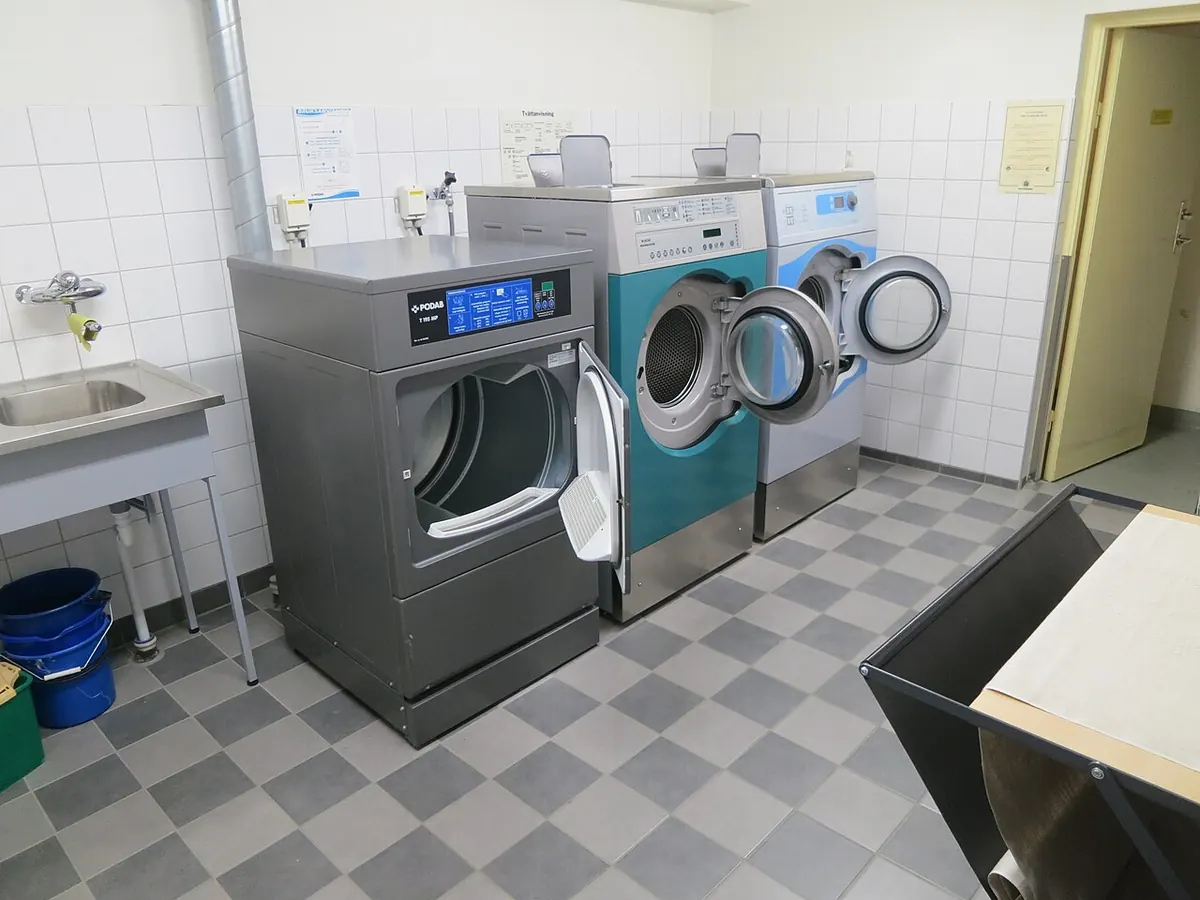

A laundry sink that fills up every time the washer drains is a drain that can't keep up with the washer's pump. Most of the time it's lint and soap residue narrowing a trap or the branch line in the wall. Sometimes it's the setup: a sink that's too small for the washer, or a hose pushed too far down. And if a toilet or tub reacts at the same time, the laundry is just where a main-line problem shows up first.
How a laundry sink and washer are usually plumbed
In Burbank, Glendale and Valley homes you'll usually find one of three setups:
- The washer hose hangs over the sink. The washer pumps straight into the laundry tub, and everything leaves through the sink's strainer, tailpiece and trap.
- A standpipe next to the sink. The washer hose drops into its own vertical pipe with its own trap. The standpipe and the sink then join the same branch line inside the wall.
- A standpipe that drains into the sink's trap. The California Plumbing Code, section 1001.2, requires a separate trap for each clothes washer and each laundry sink, with one exception: the trap serving a laundry sink may also take the waste from a clothes washer set next to it.
Code also sets the standpipe's height. Under section 804.1, a washer standpipe has to rise at least 18 and no more than 30 inches above its trap, and the trap has to sit 6 to 18 inches above the floor, not below it. A standpipe that's too short is one of the classic reasons for overflow even when the line is clear.
Why the washer overwhelms the drain
A faucet trickles. A washer pump pushes a lot of water fast. Whirlpool's drain hose installation bulletin calls for a standpipe at least 2 inches across with a carry-away capacity of at least 17 gallons per minute. If the washer drains into a laundry tub instead, the tub should hold at least 20 gallons, its top should be at least 39 inches off the floor, and no more than 4.5 inches of hose should sit below the rim. The bulletin also says not to seal the hose into the standpipe, because the washer can siphon.
So a drain that seems fine when you rinse a paint brush can still back up during the spin cycle. Once lint narrows the trap or the line, the sink fills while the pump runs and then slowly empties when it stops. That "fills, then drains" pattern is the giveaway.
Read the symptom
| What you see | Where the problem usually is |
|---|---|
| Sink fills while the washer pumps, then drains slowly | Lint and residue in the sink's strainer, trap or the branch line |
| Sink drains slowly even with just the faucet running | The sink's own trap or tailpiece, or the branch line |
| Standpipe overflows, sink drains fine | The standpipe's trap, a hose pushed too far down, or a standpipe that's too short |
| Washer water comes up in the sink through its drain | The branch line both of them share, below where they join |
| Toilet gurgles or a tub backs up when the washer drains | Probably the main line. See main line backup: what to do |
Lint: where it comes from and where it settles
Every load sheds fibers, and they leave with the drain water. Lint, hair and detergent residue cling to the inside of the trap and to the first stretch of the branch line, especially where the pipe runs nearly flat. Front-load washers catch some of it first: LG, for example, says its front-load washers have a drain pump filter that collects lint, buttons and coins, and recommends cleaning it monthly. A slow-draining washer with a full pump filter can look like a plumbing problem when it isn't.
On the plumbing side, a mesh lint catcher on the end of the drain hose or over the sink strainer stops a lot of it. Empty it after every few loads; a full one blocks the drain itself.
What to try before you call
- Stop the washer. Pause or cancel the cycle so it doesn't pump more water into a full sink.
- Clear the strainer. Pull any lint mat off the sink drain by hand, and empty the lint catcher if there is one.
- Check the hose. It should hang loosely, clipped in place, with only a few inches below the rim or inside the standpipe. It shouldn't be taped or sealed in.
- Clean the trap. With a bucket under the sink, loosen the slip nuts, take the trap off and clean it out. Plastic traps come apart by hand.
- Snake the line, if you're comfortable. With the trap off, feed a hand auger into the wall stub-out, or go down the standpipe. See how to use a drain snake. If the cable hits a hard stop, stop.
- Test the rest of the house. Flush a toilet and run the nearest tub. If they're slow too, it's not a laundry problem.
Skip chemical drain cleaners. They do little to a lint mat and leave caustic water in the sink for whoever opens the trap next. Our guide to unclogging a drain without chemicals has safer options. If the standpipe overflows on its own, our washing machine drain overflowing guide walks through it step by step.
Garage laundry and older lines
Many Valley homes have the laundry in the garage, on a long, nearly flat run of older pipe, sometimes galvanized steel or cast iron that's scaled up inside. Lint catches on that rough surface, and the line narrows a little more every year. That's why a laundry drain that keeps coming back a few weeks after a snaking usually needs the whole branch line cleaned out to the main, not another pass at the trap. Our page on why a drain keeps clogging covers repeat clogs in general.
If the washer, a toilet and a tub all react together, the restriction is further down. The pipe from your house to the street is yours to maintain: LA Sanitation says property owners are responsible for their entire sewer lateral, and that over 50% of sewer backups are caused by tree roots and fats, oils and grease. See a main line that keeps backing up and what gurgling drains mean.
What clearing a laundry drain costs in LA
These are published ranges from other LA-area plumbers and cost guides. They're a sanity check, not a quote.
| Job | Published range | Source |
|---|---|---|
| Laundry line clearing, Los Angeles | $150–$300 | A+ Electric & Plumbing |
| Single fixture drain, San Fernando Valley | $145–$295 | Last Drop Plumbing & Rooter |
| Single drain, Los Angeles | $100–$200 | Expertise Plumbing |
| Single-fixture snaking, Glendale & Burbank | $150–$350 | Alpha-Beta Plumbing (cost guide) |
| Drain cleaning, Los Angeles (average $227) | $110–$345 | Angi (Los Angeles) |
At Rooter Pros, a laundry drain clog gets a free estimate: call (818) 669-9019 and you get the price before any work begins. New customers can also ask about our $49 first-time drain cleaning coupon: one clogged drain or line cleared, new customers only, residential, Monday–Friday 7am–5pm, through an accessible ground-level cleanout, not valid with other offers. It's a new-customer special, not our regular rate. Seniors, active military and veterans get 10% off; mention it when you call. See our pricing page and the drain cleaning cost guide for more.
When to call a plumber
Call if cleaning the strainer and trap didn't fix it, if the sink fills every time the washer drains, if the clog comes back within a few weeks, if there's water on the floor, or if other drains react when the washer runs. Call too if the standpipe needs to be raised or re-trapped, since that's plumbing work that may need a permit.
Laundry sink backing up in Burbank, Glendale or the Valley? Rooter Pros finds where the line is restricted, clears it, and tells you what was in it. Licensed & bonded (CSLB #917630), open 24/7, with free estimates, flat-rate pricing and no overtime charges.
Call (818) 669-9019Prices in the table are typical published ranges from other Los Angeles-area plumbers and cost guides as of October 2026. They are not Rooter Pros quotes and change over time. Code sections are from the 2025 California Plumbing Code as published online, and washer requirements are from the manufacturers' published instructions; your city's inspector and your washer's manual have the final word. Sources are linked above.